
Solving hard, practical problems by decoding nature
12 months ago we published our original investment thesis in Decoding Nature. Since then, our founders have made extraordinary breakthroughs, and we’re seeing the next cohorts of outstanding founders decoding nature building to solve hard, practical problems in robotics, supply chains and environmental pollution.
What do we mean by Decoding Nature? It's the step changes in our ability to acquire, analyse and act on nature’s information to solve hard, practical problems across the production of food, materials and chemicals, and transform these systems into an engine for thriving ecosystems and human health.
This is ultimately accelerating us towards a near future where we will be able to interact with living systems, from human to planet scale, in a similar way to an engineer engaging with a machine. This does not replace the magic and mystery of our spiritual and relational interactions with nature.
Instead, this approach will dramatically enhance our ability to solve problems such as scaling biomanufacturing processes, sourcing the right commodity inputs at the right time for a manufacturing line or developing a medicine to remove environmental toxins from our bodies.
Our founders are already doing this.
At Basecamp Research, Glen and Oliver have just launched a world-first partnership with Anthropic to bring natural language programming to Basecamp’s enormous and proprietary biological database sourced from biodiversity, to make it easy and low cost for biotechs and pharma companies to generate novel therapeutic candidates.
Max at Hoxton Farms has launched a low cost and programmable biomanufacturing system for mammalian cells, controlled by algorithms trained on Hoxton’s vast experimental dataset mapping the relationships between parameters such as cell type and cell media components.
Greeneye Technology, led by Nadav Bocher, has just had a record quarter, with farmers queuing up to cash in on up to 90% herbicide savings every year. The company deploys AI-powered machines that distinguish crops from weeds at the nozzle level, and applies inputs only where needed. Every system operating in the field today is both generating revenue and collecting data, building what is becoming the most extensive real-world dataset of plant and weed identification ever assembled at commercial scale.
And Shely at InnerPlant, who has developed the world’s first commercial biosensor to detect early onset of crop stress, starting with fungal attack in soy. First commercial deployment in 2025, and on track to scale 10x this year. State of the art genetic engineering, remote sensing, disease pressure algorithms distilled into a simple text message to a farmer alerting them of infection in their field. with the potential to save $40/acre in unecessary fungicide application alone.
Basecamp Research, Hoxton Farms, Greeneye Technology and InnerPlant are already demonstrating that by decoding nature, ultimately our interactions with nature will become both predictable and programmable.
And this year at our Annual Investor Meeting, we shared with our investors three emerging areas in Decoding Nature in which we believe there will be standout opportunities arising over the next 12 months:
The first is in the lab itself, where nature is being decoded to produce better foods, materials and chemicals. Roboticized laboratories and AI-native bioreactors are collapsing the cost and time to do biological R&D. Processes that required years of painstaking design and pipette work can now be iterated in weeks. Giving access to rapidly growing biological datasets to LLMs is underpinning this shift. Just a couple months ago, OpenAI and autonomous lab Ginkgo Bioworks announced that GPT-5 had autonomously designed and run 36,000 biological experiments, dropping costs for synthesising a hard-to-make protein by 40%. We expect the data flywheel to be dramatic here - as datasets grow, decisions on experimental design will be more intelligent, outcomes better, and R&D cycles get shorter and shorter.
The second is in supply chain of agricultural commodities, biological materials and natural resources. These supply chains have always been opaque, but in the last 5 years volatility has become the new normal. We've seen this evolve from price swings to entire categories of input becoming unavailable from specific geographies. What has changed in the last 12 months is the capability of ai-agents to dramatically enhance a manufacturer's procurement capabilities, allowing them to cheaply and proactively both diversify their supplier base and buy based upon specific attributes of interest. This means increasing value of data collected higher up the supply chain at say the farm level, such as nutrition density or provenance, because it is easier to act upon.
The third is in the connection between environment and in human health. Pollution is the public health issue that hasn't yet had its moment, but it is coming. What's new is our ability to act at the individual level. For most of the history of environmental health, we could measure pollution in the air or water, but not easily in a specific human body. But as the cost of diagnostics falls, it is becoming possible to measure an individual's actual toxic burden — PFAS accumulation, microplastic load, pesticide exposure — and to intervene before that burden becomes disease. This year we’ve seen the first example of a startup this year that wants to build the world's first environmental health company on exactly this premise: not treating pollution as a population-level policy problem, but as something you can detect, personalise, and act on. We see the natural first customers as employers with large workforces in chemically exposed industries, and health insurers looking to get upstream of chronic disease costs.
Together, these three shifts—in the lab, across supply chains, and within our own bodies—are being driven by the convergence of the incredible developments in hardware and software that are allowing us to precisely acquire, analyse and act on nature’s information at scale.
At Systemiq Capital, we are actively backing the audacious founders who are moving us past blunt, aggregate solutions and into an era of hyper-precision, using nature as the ultimate engineering platform for a future of abundance.
If you’re solving hard, practical problems by decoding nature, I want to hear from you.
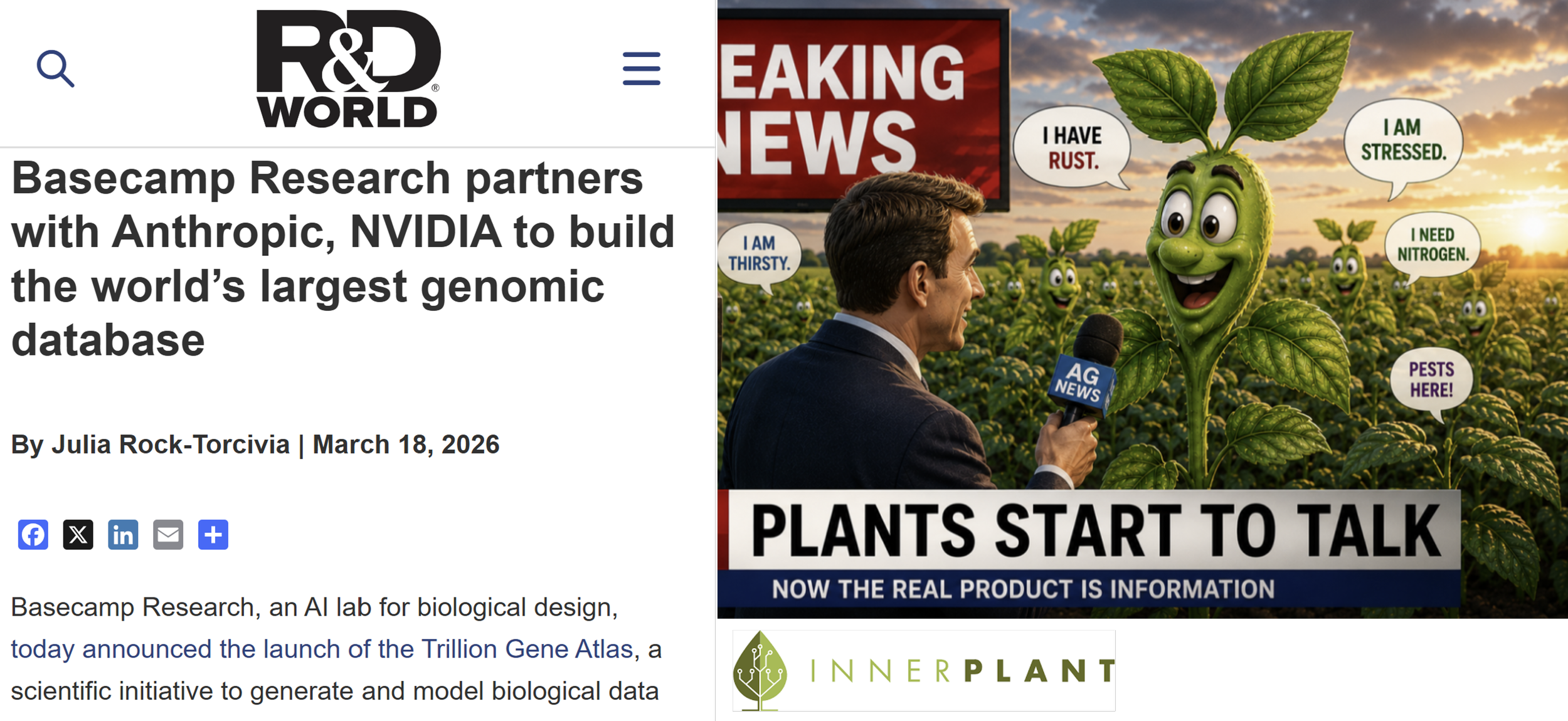
Basecamp Research are partnering with Anthropic and Nvidia to decode the word’s largest genomic database sourced from biodiverse ecosystems all over the world to develop the next generation of life saving therapies, while InnerPlant have combined genetic engineering and AI to enable plants to communicate their needs directly to farmers. Decoding Nature in action par excellence.