
The Physical Economy Briefing, September 2026
Each month the Systemiq Capital team shares what it's seeing across the systems we invest in, on LinkedIn, on stages and in the field. This is the monthly recap, with the month's thinking gathered in one place. Follow the team for the running commentary; the originals are linked throughout.
The month in one line
AI's next constraints are physical. In compute, the constraint is how much light survives the trip to the chip. In biology, it is access to data that only trust can unlock.
Compute beyond silicon: optics are reaching the chip
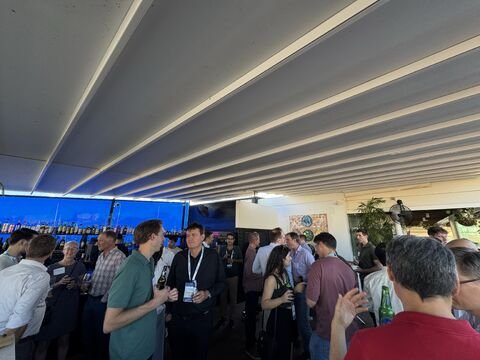
Optical interconnect is becoming the deciding layer in AI compute, and its engineering trade-offs are getting sharper. Jasper Wigley reported back from ECOC in Málaga, one of the main conferences for the global photonics community, where Systemiq Capital co-hosted an evening with M Ventures and Vsquared Ventures (read his post).
400G per lane is now running, with Marvell and Coherent both demonstrating it. Reach is the catch. Doubling the baud rate costs roughly 4x in dispersion tolerance, so links that reach 2km at 200G PAM4 drop to a few hundred metres at 400G. That raises the question of whether IMDD starts to lose its grip.
Co-packaged optics link budgets are tighter than most people assume. Once the laser sits in a front-panel module, light passes through three or four connectors before it reaches the modulator. The ELSFP alone can cost 3dB, and each expanded-beam connector another 0.5 to 1.5dB, so up to half the photons can be lost before doing any useful work. Molex, Furukawa and Coherent are all working on this, and connectors are becoming a strategic asset. Mixx Technologies' platform is among those at the forefront.
imec's message was that AI scaling no longer works on CMOS alone: silicon photonics, 3D stacking and packaging have to be designed as one roadmap. Huawei's plenary set out the I/O sequence that most vendors on the floor fitted into: near-packaged optics, then co-packaged optics, then optical I/O directly off the die as electrical lanes push past 224G. Optics reaching the chip is settled. Who owns the optical engine is not.
This builds on August's anchor piece, Jasper's "Beyond Silicon", on compute gains moving off the chip.
Decoding Nature: Basecamp Research raises a $140m Series C
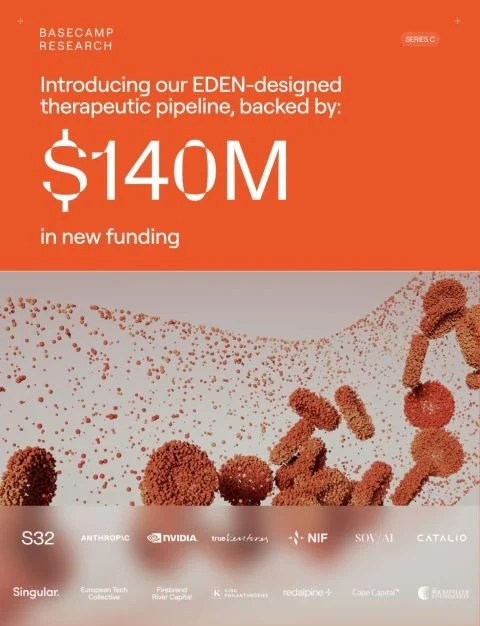
Basecamp Research has raised a $140m Series C led by Andy Conrad at S32. Systemiq Capital led the company's Series A in 2022. Founders Glen Gowers and Oliver Vince started from one premise: training AI to understand biology requires an internet of biology, and nature already holds one. Basecamp Research now holds the world's largest and most diverse protein database, with more than 100 billion novel genes found in nature, and its proprietary EDEN models have delivered several world firsts. The raise follows the partnership with Anthropic announced in July.
George Darrah's point (read his post here) is that this database could not have been bought. It was built on trust, earned across many countries and contexts by the founders and by the leaders they brought in to do this work, including Bupe Mwambingu and Emma Bolton. The model is designed so that biodiverse countries are paid when their genetic assets are developed. The commercial goal is to use biodiversity's information to treat diseases that are currently incurable. Assets like this are defensible because capital alone cannot reproduce them.
Also this month
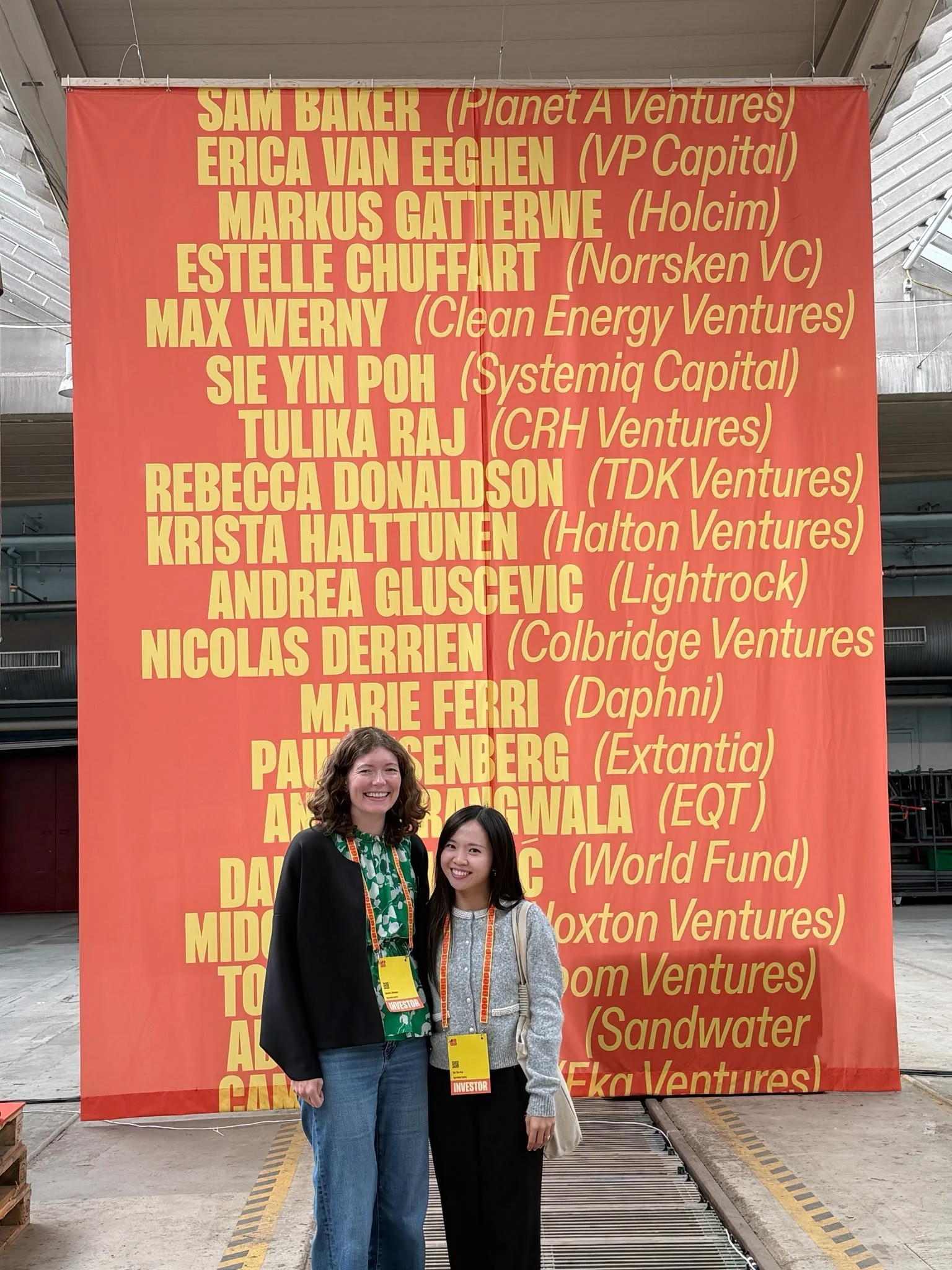
George Darrah, Gemma Bloemen and Sie Yin Poh were at The Drop in Malmö this month.
On 15 September, George and Gemma co-hosted "Ahead of Limited", the official LP breakfast at The Drop, with Eka Ventures.
Gemma also led a Ripple session with Camilla Dolan, "Physical AI: Unlocking heavy industry".
Sie Yin was also at Autonomy, where debate centred on physical AI, sovereign AI and who is positioned to win. Read her post.
Systemiq Capital is a venture capital firm backing audacious founders redefining the physical economy, building category-defining companies in systems we understand deeply. The firm invests at Series A +/– across the UK, Europe and the US, focused on Electrification, Decoding Nature and Applied AI.
Frequently asked questions
What does Systemiq Capital invest in? Systemiq Capital backs founders redefining the physical economy, building category-defining companies in Electrification, Decoding Nature, and Applied AI.
What stage does Systemiq Capital invest at? Systemiq Capital invests at Series A +/–, across the UK, Europe, and the US.
What is "physical economy" venture capital? Physical economy venture capital refers to investment in companies building into the systems that power, produce, and move the real world — energy, industrial infrastructure, natural resource production, and the compute and intelligence layered on top of them. It is distinct from software-only or consumer-first venture investing, and requires deep understanding of the market forces, infrastructure dynamics, and system conditions that shape a company's path to scale.
What are Systemiq Capital's three investment verticals? Electrification (how energy is traded, managed, and used, and how compute is built to run on it), Decoding Nature (technology and nature combined to act on information not previously available, driving more productive and resilient natural resource production), and Applied AI (intelligence applied across industrial systems, infrastructure, and complex operating environments).
What makes Systemiq Capital different from other venture firms? Systemiq Capital's edge comes from systems understanding, a deep grasp of the market forces, industry dynamics, and system conditions that shape a company's path to scale and commercial value, combined with specialist expertise, relevant networks, and commercially grounded support for founders.
Does Systemiq Capital invest in hardware? Around half the companies Systemiq Capital backs have a hardware component: sensors, bespoke hardware with a software layer on top, or fully embedded robotics. The firm does not invest in first-of-a-kind deployments or early science, and treats hardware as a source of defensibility rather than a reason to avoid a company.
Why does Systemiq Capital invest in compute infrastructure? Compute sits inside Systemiq Capital's Electrification vertical, which covers how energy is traded, managed and used, and how compute is built to run on it. As gains from shrinking silicon plateau, performance is increasingly won in packaging, power delivery, memory architecture and non-silicon computing, all of which are physical infrastructure problems.