
Beyond Silicon
A year ago, I wrote about a collision. Moore's law, the engine that made computing predictably faster and cheaper for half a century, had run into the physics of atomic limits. At the same moment, AI demand went vertical. The free lunch ended just as the world sat down to eat. That piece closed with a promise to watch this space; this one is about what we did next, and how we view the future.
We have made our first two investments in advanced computingand sharpened our view of where the next decade of progress will come from. For fifty years it came from shrinking silicon transistors. Now that shrinking has stopped paying, the gains are migrating beyond the silicon itself; into how chips are packaged, how data moves between them, how systems remember, how power reaches the processor, and looking to the future, into machines that are not conventional silicon at all. That is where we are investing.
The Intelligence Substrate Underpinning Everything
Computing is the intelligence substrate of the physical economy.
A physical input becomes information, computation happens in the middle, and a physical output comes back. A sprayer reads a weed in a field and decides to fire. A grid balances supply and demand minute by minute. A model reads a disease target and designs a therapeutic. A satellite decides which of its images matter before it sends a single byte to the ground.
Every company Systemiq Capital backs lives somewhere on that loop, whether the theme is Electrification, Decoding Nature or Applied AI. Compute is the substrate underneath all three. And that substrate is not confined to the data centre, or even to silicon; it runs from the chip package to the rack to the grid, out to the vehicle, the factory line and increasingly into orbit, and it will be built from whatever physics does the job best, electrons, photons and in time qubits.
And the substrate is not only hardware; it includes the software pressed up against it, the kernels, compilers, runtimes and orchestration layers that decide how much useful work the physics actually does.
For the first time in fifty years, the cost and energy curve of that substrate is uncertain.
The rise of AI has caused the first increase in power demand across the developed world in two decades, and data centres are on track to nearly double their electricity consumption by 2030.
The same grids that must electrify transport, industry and buildings are now feeding computation; without a step-change in efficiency, AI and electrification will end up competing for the same electrons.
Even once you get to the data centre, more than 30% of the electricity entering the facility is wasted before it ever reaches a processor, lost across successive conversion stages and voltage regulators.
Bending the demand curve on compute energy is one of the highest-leverage systems change opportunities of the decade, and unusually, one where the commercial incentive and the climate outcome point in exactly the same direction. Hyperscalers do not buy efficiency because it is virtuous; they buy it because their margins, their capacity to grow and increasingly their licence to operate depend on it. Change that has to be subsidised is tough; impact that customers fight to pay for scales.
Efficiency is only half the story, though.
Some of what is emerging in this space does not just improve the curve; it changes what is possible. Quantum processors will simulate the chemistry and materials that classical machines cannot. Compute in orbit puts intelligence where there is no grid and no fibre. New sensing and processing paradigms give physical systems capabilities they have simply never had. Powering better intelligence, whether in a data centre, on the grid or aboard a spacecraft, is central to smarter physical systems and to the energy transition itself.
That is why advanced computing sits within our Electrification theme, and why in practice it is the foundation the whole portfolio stands on.
What we back
Our approach follows from that.
We back IP-rich, asset-light companies doing one of two things; bending the demand curve on compute energy, or opening capabilities that conventional silicon cannot reach.
The first delivers more useful compute per watt, per rack and per dollar of capital. The second changes what can be computed and where computation can live, and in doing so opens possibilities for the systems we invest in that did not exist before.
There is no magic chip coming to save us.
The next decade of progress comes from rethinking the entire stack; how electrons enter the data centre, how they are regulated at the chip, how data moves between processors, how heat leaves the rack.
Every layer is now a place where meaningful gains can be won, and every layer has incumbents struggling to move at startup speed. That stack does not stop at hardware either; the kernels, serving layers and agent infrastructure that determine how efficiently intelligence runs are as much a part of the substrate as the silicon underneath them.
The way to build here has changed too. Hyperscalers now buy and qualify full reference architectures rather than loose components, an OCP-shaped world that rewards small teams who can ship a system rather than a part; and companies can own the IP at a critical layer while partners like TSMC, Samsung and STMicroelectronics carry the manufacturing, the fabless model finally arriving in analog, power and photonics, not just digital logic, which is what finally makes semiconductors venture-investable without the balance sheets the sector historically demanded.
Our first two investments show the shape of this.
Mixx Technologies is replacing the copper connections inside frontier AI systems with light; the same shift that transformed long-distance telecoms, now arriving inside the rack as co-packaged optics, delivering far more bandwidth per watt.
Claros designs a voltage regulator small enough to sit directly underneath the AI chip itself, so that power arrives precisely where it is needed rather than losing itself as heat along the way.
Both are design companies whose manufacturing is carried by the industry's best partners; both were founded by teams who had already shipped this class of technology into production; and, tellingly, the two bookend the rack, Mixx on how data moves through it, Claros on how power enters it.
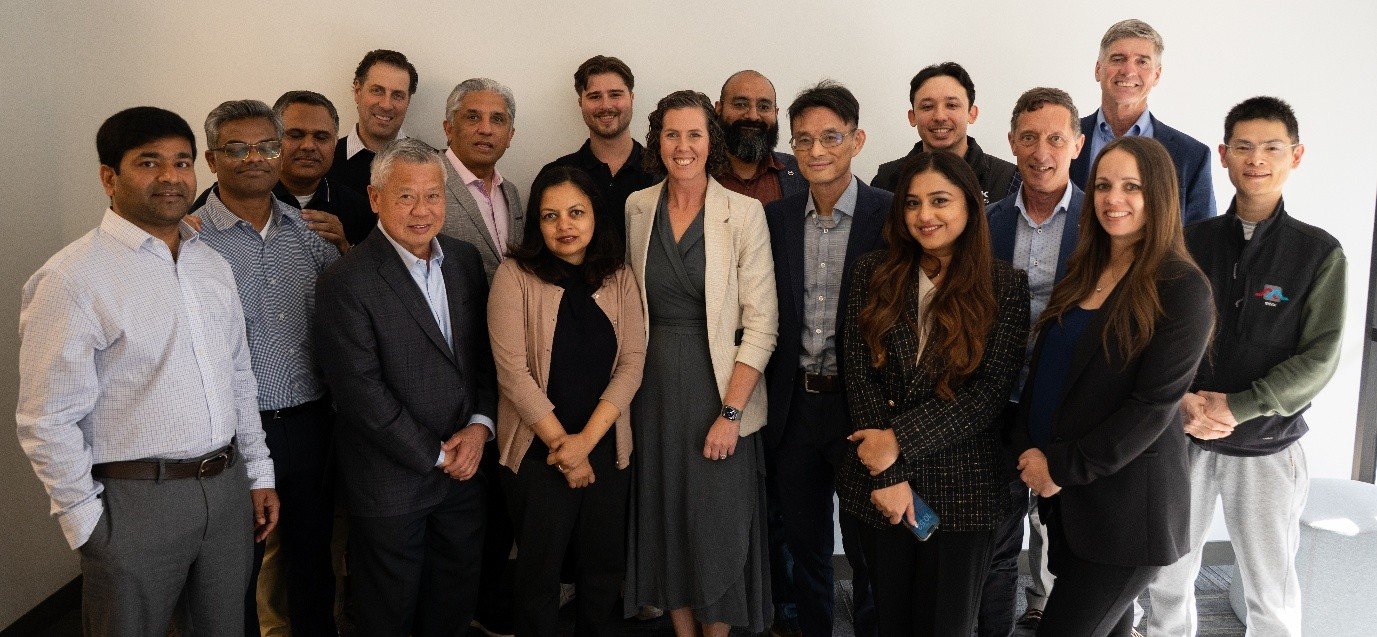
Jasper with the Mixx Technologies team, in San Jose
Where we are hunting next
Four themes are shaping our pipeline this year.
Inference is moving to the edge.
Training frontier models will stay in hyperscale data centres, but using them increasingly happens where the data is; on the robot arm, in the vehicle, at the factory line, on the satellite.
The reasons are practical. Latency matters when a machine is making a physical decision, sensitive data is better processed where it is generated, and every watt of inference handled at the edge is a watt the grid never has to deliver to a data centre.
We see this demand pull directly in our own portfolio; Archetype AI runs its physical agents on machines themselves rather than in the cloud, because the major cloud models simply cannot be adapted to do so. The opportunity is in inference-first silicon, low-power accelerators, and the quantisation, sparsity and compilation techniques that let capable models run within tight energy budgets. The loop I described above tightens when the computation sits next to the sensor.
Memory is becoming the bill.
The industry conversation has moved from training models to serving them, and the bottleneck has moved with it. Serving a model is really two jobs; reading the prompt, which is hungry for raw compute, and writing the answer, which is hungry for memory, and the leading operators are beginning to split the two across different hardware. In industry terms, prefill and decode are pulling apart, and memory is fast becoming the most contested object in inference economics, stored, moved, compressed and reused across every tier of the hierarchy.
Meanwhile workloads have become wildly heterogeneous; multi-modal models, agents that run for hours, contexts that stretch to millions of tokens. Through all of it, the model must hold the entire task in a kind of working memory, the KV cache, and on long tasks that working memory can outgrow the model itself. In plain terms, the cost of an AI answer is increasingly set not by how fast the chip thinks but by how much the system can remember and how quickly it can fetch it.
The response is a whole new memory hierarchy, tiering from HBM stacked on the GPU down through CXL-attached system memory and flash, along with hardware that brings computation closer to where data lives. We are actively looking for companies here.
Packaging and connectivity are converging.
With the transistor no longer shrinking cheaply, performance gains have moved to how dies are stacked, bonded and connected; what the industry calls advanced packaging, and what is really scaling inwards rather than downwards.
Packaging capacity, not chip design, is now among the tightest constraints on AI hardware supply. And the toolkit is expanding fast; logic stacked directly on logic, memory bonded straight onto compute, copper-to-copper hybrid bonds replacing solder bumps at a fraction of the pitch, and interposers evolving from passive silicon and glass into active layers that route power and signal themselves. Each of those steps demands new equipment, new materials and new test and metrology, and the supplier base for that ecosystem is still being formed; the returns in packaging historically went to the foundries, and this is the first moment where they are genuinely up for grabs.
At the same time, the optical boundary is crossing into the package itself. When we invested in Mixx, co-packaged optics was a contrarian bet; this year it entered production at the industry's largest players, with UCIe and the first co-packaged optics standards emerging to build a multi-vendor ecosystem around it. The debate about whether is over.
The question now is who supplies that ecosystem; the lasers, the fibre attach, the connectors, the test and reliability infrastructure that a technology needs once it ships in volume.
Power electronics have found their own Moore's law.
While transistor scaling stalled, a quieter improvement curve kept compounding.
New semiconductor materials, silicon carbide and gallium nitride, handle high voltages and heat with a fraction of the losses of ordinary silicon, and each generation gets meaningfully denser and more efficient.
That curve made electric vehicles viable, and it is now transforming how data centres deliver power, the move to 800V DC distribution running from the grid connection down to regulators sitting millimetres from the chip.
Each stage of that descent, from tens of kilovolts at the fence line to under a volt at the transistor, is its own conversion problem with its own losses, and each is a place where new materials, new device structures and new ways of owning the manufacturing can win.
Power electronics’ next frontier is space, where every gram and every watt is priced brutally, and where power infrastructure for satellite constellations and in-orbit compute must be smart, dense and fault-tolerant from day one. The same logic, in a far harsher environment; and a vital next paradigm for the substrate we invest in.
Where the companies come from
The honest geography of this industry is that the United States has the density, because the customers and the strategic acquirers are there and proximity compounds. Both of our first two investments are American companies. But Europe holds genuine pockets of gravity; AI research in London, semiconductor tooling in the Netherlands, robotics in Zurich, and more; the best European teams now build global companies from day one rather than treating the US as a distant second act. Our job as a transatlantic investor is to be the bridge; helping European founders reach the ecosystem where their customers sit and bringing an independent perspective to American companies from outside the Valley bubble.
The founders we are looking for
The people who win in this space understand that it is a game of system design, manufacturing readiness and supply chain relationships.
Some learnt that over decades inside the industry's biggest names; others are younger builders who surround themselves with people who did.
What they share is a conviction that reliability and manufacturability beat benchmarks, and that the supply chain is a first-class part of the product. If that sounds like you, we would love to talk. The free lunch is over.
The companies that replace it will be some of the most important of the next decade.