
8 Technologies Decoding Nature's Information Layer
TL;DR
- Decoding nature means combining sensors, compute, and machinery to read and act on information humanity has never captured before, across wild nature (forests, oceans, soil) and engineered nature (agriculture, biomanufacturing).
- Every technology below maps onto a three-part value chain. Sensors acquire the data, algorithms and compute convert it into information, and robotics or engineered systems act on it.
- This is a venture framing, not a conservation one. The commercial thesis holds that nature's value is moving from biomass to information, and the first movers who acquire, interpret, and act on that information win.
What "decoding nature" means and why it's a technology stack, not a slogan
Decoding nature means combining sensors, compute, and machines to read and act on information that human beings have never been able to see before. The information sits inside two distinct domains. Wild nature covers earth's own systems, the forests, oceans, soils, and species that run without human input. Engineered nature covers the processes humans have adapted for production, including agriculture, fermentation, and biomanufacturing. Both domains generate signals. Neither has been machine-readable at scale until recently.
Every technology in this list maps onto the same three-part value chain. The first stage acquires data through sensors, whether that means a satellite scanning a coastline, a water sample carrying environmental DNA, or a plant reporting its own stress. The second stage converts that raw data into information through algorithms and compute, turning a spectral reading into a species count or a genome into a usable enzyme. The third stage takes action through robotics and engineered systems, sending a machine into a forest or editing a microbe to produce a chemical. A company can own one stage or stitch several together, but the chain holds across all eight entries below.
The reason this became investable now comes down to cost. Sensing, sequencing, and compute have each dropped in price by an order of magnitude or more over the past decade, and the declines feed one another. Cheaper satellites flood the market with earth observation data. Cheaper sequencing turns a soil sample into a full genetic readout. Cheaper AI inference makes it economical to search that flood for patterns no analyst could find by hand. When acquisition, interpretation, and action all fall in price at once, information that used to be locked inside physical biomass becomes an asset a business can acquire, price, and build on.
That shift is what separates decoding nature from a conservation pitch. The signals were always there in the water, the soil, and the atmosphere. What changed is that reading them stopped being expensive. The categories that follow each sit somewhere on the value chain, in one of the two domains, and each one rests on a cost curve that recently crossed into commercial range.
1. Environmental DNA and biodiversity sensing
Every organism sheds genetic material into its surroundings, and environmental DNA sensing reads that trace to identify which species have passed through a site. A single water or soil sample, run through a sequencer and matched against a reference database, returns a species-level inventory without a single field biologist walking a transect. That collapses the cost and time of a biodiversity survey from weeks of specialist labor to a sample in a vial.
The commercial value comes from turning that inventory into an input other systems can act on, not from the ecological reading itself. Mining and infrastructure developers face permitting rules that require biodiversity baselines before they break ground. Companies with land-use commitments need to prove that a site holds the species they claim, and lenders increasingly want the same evidence attached to a loan. Environmental DNA supplies a repeatable, auditable measurement where previous methods produced expensive, inconsistent expert opinions.
[Nature Metrics](https://systemiqcapital.earth) has built its business on this exact conversion, processing samples into biodiversity reports for clients who treat the data as a compliance and monitoring feed rather than a research curiosity. As sequencing costs fall, the price of a single reading drops toward the point where continuous site monitoring becomes routine. That shift moves biodiversity from a one-off assessment into a data stream businesses can build on.
2. Low-cost space and satellite sensing
Falling launch costs have turned earth observation from a scarce, government-controlled resource into a commodity data stream. A kilogram to orbit cost roughly $60,000 in the Space Shuttle era. SpaceX pushed that below $3,000 with Falcon 9, and Starship aims to cut it by another order of magnitude. Each drop in launch price lets operators put more satellites in orbit, and more satellites mean more frequent, higher-resolution imaging of any point on the planet.
That flood of data changes the economics for anyone building on top of it. When imagery of a forest, a coastline, or a field arrives daily instead of monthly, and costs a fraction of what it once did, the constraint moves off the sensor and onto the software. A company monitoring deforestation, crop stress, or methane leaks no longer has to fund its own space program to get the raw pixels. It buys them.
Cheaper acquisition lowers the barrier for downstream analytics companies specifically. The value migrates from owning the satellite to interpreting what the satellite sees, which is where most of the venture-scale businesses will form. Abundant, affordable observation data is the acquisition layer that makes species tracking, land-use verification, and environmental compliance markets viable at all.
3. Space-hardened edge compute
A satellite that sends every raw image back to earth wastes most of its bandwidth on data nobody will use. Space-hardened edge compute solves that by running the analysis onboard, so the satellite transmits only the answer instead of the entire dataset. A wildfire-detection system, for example, can flag a hotspot from orbit and downlink a single alert rather than hours of imagery a ground station has to process later.
The commercial edge comes from two places. First, the decision loop shrinks. When a satellite identifies a change and acts on it in the same pass, downstream customers react in minutes rather than waiting for the next ground contact and a processing queue. Second, transmission costs drop sharply, because bandwidth to and from orbit stays scarce and expensive even as launch gets cheaper. A company that reduces what it sends keeps its operating costs flat while its data volume grows.
The hard part is that space is a brutal place to run a chip. Radiation flips bits and destroys consumer processors, so onboard compute has to survive conditions no data center faces. [Ramon Space](https://systemiqcapital.earth) builds radiation-tolerant processors that bring modern computing performance into orbit, giving satellites the ability to interpret their own sensor feeds. That capability turns a satellite from a camera that ships pictures home into a machine that produces information where the data is captured.
4. AI inference and compute scaling applied to natural systems
The sensors and satellites in the earlier entries produce more data than anyone can read, and collapsing inference costs are what make that data usable rather than stored. The cost of running a trained model against new input has dropped roughly 1000x over the past few years, which changes what you can afford to analyze. When each prediction costs a fraction of a cent, you can run a model across every acre of forest, every water sample, and every field image without the compute bill breaking the business.
For natural systems specifically, that cost curve matters because the data is messy and the patterns are subtle. Identifying an invasive species from a genetic fragment, spotting early crop disease across a continent, or tracking soil carbon change requires running inference at a scale that was uneconomical five years ago. The models existed. Running them against planet-scale data at a price that supports a commercial product did not.
Nvidia sits underneath most of this as the infrastructure layer, supplying the GPUs and software that make cheap inference possible. It is not a decoding nature company, and treating it as one misses the point. Nvidia is the reason a biodiversity analytics startup or an agricultural AI firm can turn raw sensor feeds into species-level or field-level intelligence without owning a data center. The founders building category-defining businesses in this space rent that capability rather than build it, and they price their products around inference costs that keep falling.
5. Field robotics and teleoperation
Sensing and compute tell you what is happening in a natural system, but someone still has to act on it. Field robotics closes that loop, putting machines into environments too remote, hazardous, or physically demanding for reliable human labor. The action layer splits along the same wild and engineered divide as the rest of the stack.
In wild nature, the work happens in places people struggle to reach safely. Kodama builds teleoperation and autonomy systems for forestry machinery, letting a single operator run heavy equipment across steep or fire-prone terrain from a remote station. That removes the operator from the most dangerous part of the job and lets one person cover ground that used to need a full crew on site.
In engineered nature, the machines work alongside crops rather than raw wilderness. Aigen deploys solar-powered field robots that move through farmland and remove weeds mechanically, cutting the herbicide a grower would otherwise spray across the same acreage. The robot acts on plant-level information directly in the row, not from an office dashboard.
Both companies convert the earlier layers into physical outcomes. A satellite image or an eDNA reading only creates value once a machine can respond to it in the field, and robotics is what turns that reading into a felled tree, a cleared row, or a maintained forest without putting a person in harm's way.
6. Low-cost genomic sequencing and biodiscovery
Genomic sequencing costs have dropped roughly 90% over the past decade, and that collapse turned reading DNA from a research luxury into a routine input for building products. Sequencing a genome once cost enough to gate the work to well-funded labs. Now companies can sequence at volume, which changes what they do with the output. The value has moved from reading genomes to acting on them, and that shift is where the commercial opportunity sits.
Cheap sequencing feeds two distinct plays. The first is biodiscovery, mining genetic diversity for enzymes, proteins, and compounds that do something useful in industry or medicine. [Basecamp Research](https://systemiqcapital.earth) works this angle by collecting genetic data from extreme and understudied environments, then building a proprietary database of sequences that don't exist in public repositories. That dataset becomes the raw material for discovering novel enzymes and training biological AI models, and its value grows as competitors keep sampling the same well-known organisms.
The second play sits closer to the hardware. [Portal Biotech](https://systemiqcapital.earth) focuses on protein sequencing rather than DNA, reading the molecules that actually carry out biological function. Proteins are harder to sequence than genes, and Portal's technology aims to make protein-level readout as accessible as DNA sequencing already is. Together the two companies show the pattern across biodiscovery. One side builds the reference data that makes discovery possible, and the other side builds the instruments that expand what you can read in the first place.
7. Crop and plant biosensing
Plant biosensing puts the sensor inside the crop itself, so the plant reports its own stress before a grower can see damage. Traditional remote monitoring reads a field from above with satellites or drones and infers problems from color and canopy changes. By the time chlorophyll shifts enough to register from orbit, the disease or nutrient deficit has already spread. Engineering the plant to signal its internal state closes that gap.
InnerPlant engineers crops to emit an optical signal when they experience a specific stress, such as fungal infection or water shortage. A grower detects that signal early with a sensor and treats the affected zone before the problem moves across the field.
The commercial upside is input efficiency. A grower who knows exactly which plants need fungicide, water, or nitrogen sprays less and protects more yield. Blanket applications waste chemicals on healthy plants and still miss early outbreaks. Targeted response driven by the plant's own signal cuts input costs and defends the harvest at the same time. For row crops at scale, a few percentage points of saved input or protected yield compounds into a large margin difference across millions of acres.
8. Materials and structure-function decoding
Material performance comes down to atomic and microstructural arrangement, yet most R&D still discovers that link through slow physical trial-and-error. A team synthesizes a candidate alloy or polymer, tests it, adjusts the recipe, and repeats. Each loop burns weeks and lab budget, and the number of possible structures far exceeds what any team can physically make.
Structure-function decoding attacks that bottleneck by learning the relationship between microstructure and properties directly from imaging and simulation data. Once a model maps how grain size, phase distribution, or crystal orientation drives strength, conductivity, or fatigue resistance, you can screen candidate structures computationally before committing to synthesis. That collapses the search space and points R&D at the handful of designs worth actually making.
Polaron builds this layer for advanced materials. Its models read microstructural images and predict how a given structure will perform, so materials teams optimize designs in software rather than at the bench. For manufacturers of batteries, magnets, and structural alloys, that shifts development from guessing to targeted engineering.
The commercial pull is speed to a working material. A company that reaches a qualified alloy or electrode formulation months ahead of a rival captures the supply contract first. Decoding the structure-function link turns materials science into a search problem you can run at compute speed rather than lab speed.
Comparison table: the decoding nature stack
Each technology below occupies a specific position in the value chain and touches either wild or engineered nature. The table maps all eight against those two axes and names the companies proving each one out.
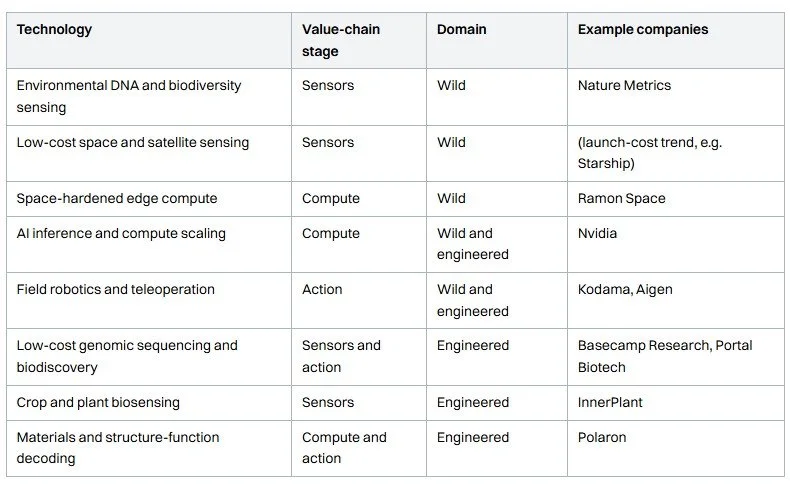
Read the table top to bottom and the pattern holds. Wild nature dominates the sensing end, engineered nature dominates the action end, and compute sits underneath both.
Why this is a venture thesis, not a conservation thesis
Nature's economic value has always sat in its biomass. A forest was worth its timber, a fishery its catch, farmland its yield. That basis is moving to information. A forest that can be sequenced, sensed, and modeled at species level carries data with commercial value independent of anything you harvest from it. The companies that acquire, interpret, and act on that data first are the ones defining new markets.
Those markets are concrete, not abstract. Cheaper genomic sequencing feeds enzyme and strain discovery for industrial biology and chemicals. Plant biosensing and eDNA feed food production and land-use decisions. Atomic-scale structure mapping feeds new materials that reach performance targets without decades of trial-and-error R&D. Each category rewards whoever builds the acquisition and interpretation layer before a standard exists, because the first credible dataset becomes the reference everyone else licenses or competes against.
The three-part value chain explains why timing matters. Falling costs in sensors, compute, and sequencing have pulled acquisition and interpretation within reach of venture-scale companies rather than national labs. A founder who owns proprietary data at the sensor layer, runs cheaper inference on it, and closes the loop with robotics builds a business competitors cannot easily replicate. That combination produces defensibility, not just a product.
Systemiq Capital backs founders operating at this frontier under its Decoding Nature vertical, one of three theses alongside Electrification and Applied AI. The bet is straightforward. As nature shifts from a source of biomass to a source of machine-readable information, the businesses that treat it that way will lead food, materials, chemicals, and industrial biology. The eight technologies above are the toolkit those founders are assembling, and the returns follow whoever assembles them first.